Art and Remembrance the Legacy of Felix Nussbaum Pdf
| Felix Nussbaum | |
|---|---|
 Self Portrait with Jewish Identity Card (1943) | |
| Born | (1904-12-xi)xi Dec 1904 Osnabrück, German language Empire |
| Died | ix Baronial 1944(1944-08-09) (aged 39) Auschwitz, German language-occupied Poland |
| Nationality | German |
| Known for | Painting |
| Movement | New Objectivity |
| Website | www |
Felix Nussbaum (December 11, 1904 – August 9, 1944) was a German-Jewish surrealist painter. Nussbaum's work gives a rare glimpse into the essence of one person amid the victims of the Holocaust.
Early life and education [edit]
Nussbaum was born in Osnabrück, Germany, equally the son of Rahel and Philipp Nussbaum. Philipp was a World State of war I veteran and German patriot earlier the rising of the Nazis. He was an apprentice painter when he was younger, but was forced to pursue other means of piece of work for fiscal reasons. He therefore encouraged his son'southward artwork passionately.
Nussbaum was a lifelong student, beginning his formal studies in 1920 in Hamburg and Berlin, and continuing as long as the contemporary political situation allowed him. In his earlier works, Nussbaum was heavily influenced by Vincent van Gogh and Henri Rousseau and he eventually paid homage to Giorgio de Chirico and Carlo Carrà every bit well. Karl Hofer'southward expressionist painting influenced Felix'south conscientious approach to colour.
In 1933, Nussbaum was studying under a scholarship in Rome at the Berlin Academy of the Arts when the Nazis gained control of Germany. Adolf Hitler sent his Minister of Propaganda to Rome in April to explain to the creative person elites how a Nazi artist was to develop, which entailed promoting heroism and the Aryan race. Nussbaum realized at this bespeak that, as a Jew, he could not remain at the academy.
Deportation to death camps [edit]


The next decade of Nussbaum's life was characterized past fear, which is reflected in his artwork. In 1934 he took Felka Platek, a painter whom he had met while studying in Berlin and would later marry during their exile in Brussels in 1937, to see his parents in Switzerland. Felix's parents eventually grew homesick for Deutschland and, against his fierce objections,[ane] they returned. This was the last time Felix would run across his mother and male parent — the source of his spiritual and financial support. Felix and Felka would spend the next x years in exile, mostly in Belgium, a flow of emotional and artistic isolation for him just also ane of the nigh artistically productive times in his life.[ii]
Subsequently Nazi Deutschland attacked Belgium in 1940, Nussbaum was arrested past Belgian police as a "hostile alien" German, and was subsequently taken to the Saint-Cyprien camp in France. The desperate circumstances in the army camp influenced his pictures of that time. He eventually signed a request to the French camp authorities to be returned to Germany. On the train ride from Saint Cyprien to Germany, he managed to escape and rendezvous with Felka in Brussels, and they began a life in hiding. Without residency papers, Nussbaum had no way of earning an income, just friends provided him with shelter and fine art supplies and then that he could continue his arts and crafts. The darkness of the next four years of his life can be seen in the expression of his artwork from that period.
In 1944, the Nussbaum family unit was profoundly impacted by the plans of Nazi Germany. Philipp and Rahel Nussbaum were killed at Auschwitz in Feb. In July, Nussbaum and his wife were found hiding in an attic by German language armed services. They were arrested, sent to the Mechelen transit military camp and given the numbers XXVI/284 and XXVI/285. On Baronial ii they arrived at Auschwitz, and a week afterwards Felix was murdered at the historic period of 39. On September three, Nussbaum's brother was sent to Auschwitz, and on September half dozen his sister-in-law and niece were also murdered there. In December, his blood brother – the last of the family unit – died from exhaustion in the camp at Stutthof. Within one year, the entire Nussbaum family unit had been murdered.
Major works [edit]
In this fourth dimension period, Nussbaum created two of his all-time-known works: Self Portrait with Jewish Identity Card (1943), and Triumph of Expiry (1944).
Triumph of Death [edit]
Triumph of Decease shows Nussbaum's attention to detail. According to his biography, Felix Nussbaum: Fine art Defamed; Fine art in Exile; Art in Resistance, the crumpled music score has the first several bars of "The Lambeth Walk", a popular song from the musical Me and My Girl. The words that would normally accompany the music are "Ev'rythin' complimentary and easy / Do as you darn well please".
Selected paintings [edit]
-
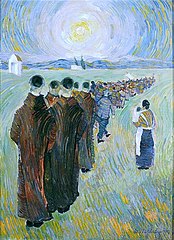
Remembering Grüßau
-

Fairground
-

The Surreptitious
-

Puppets
-

Self-portrait with Towel
-

The Desolate Street
-

The Triumph of Expiry
-

The Refugee
Legacy [edit]

Felix Nussbaum'due south artwork affords a rare glimpse into the mind of one individual among the victims of the Holocaust. In 1998, the Felix Nussbaum Haus in Osnabrück opened its doors to showroom the artworks of Felix Nussbaum.
He was featured aslope fellow concentration camp survivors and artists Jan Komski and Dinah Gottliebova in the 1999 documentary film Eyewitness, which was nominated for an Academy Award for Documentary Short Subject.[three] [4]
Fine art and Remembrance: The Legacy of Felix Nussbaum is a 1993 documentary directed past Barbara Pfeffer.
References [edit]
- Citations
- ^ Felix Nussbaum at www1.yadvashem.org
- ^ "Arts in Exile". German language National Library. Retrieved 31 January 2014.
- ^ "NY Times: Bystander". Movies & Television Dept. The New York Times. 2012. Archived from the original on 2012-10-xvi. Retrieved 2008-12-06 .
- ^ "Eyewitness". Seventh Fine art Releasing. Retrieved 7 March 2012.
- Bibliography
- "Friedensstadt Osnabrück - Felix Nussbaum" Archived 2008-02-09 at the Wayback Machine
- Karl, Kaster Thou. Felix Nussbaum: Art Defamed, Art in Exile, Art in Resistance. 1st English ed. Overlook, 1997.
- "Ten Dreams: Felix Nussbaum Galleries"
- Berger, Eva (2007). Felix Nussbaum : verfemte Kunst - Exilkunst - Widerstandskunst (in German language) (4 ed.). Bramsche: Rasch. ISBN978-3-89946-089-6.
External links [edit]
- Felix Nussbaum - online exhibition from Yad Vashem
- Werkverzeichnis
- Ten Dreams Galleries
- The Felix Nussbaum Haus (Museum)
gammagearence1989.blogspot.com
Source: https://en.wikipedia.org/wiki/Felix_Nussbaum
0 Response to "Art and Remembrance the Legacy of Felix Nussbaum Pdf"
Post a Comment